Graduate Student (G6)
B.S. in Chemistry and Spanish, The University of Wisconsin, Madison, 2019
Graduate Student (G6)
B.S. in Chemistry and Spanish, The University of Wisconsin, Madison, 2019
Graduate Student (G6)
B.S. Chemistry, University of Maryland, 2018
B.S. Chemistry, Peking University, China Advisor: Na Li, 2011
Ph.D. Chemistry, The Ohio State UniversityAdvisor: Dongping Zhong, Robert Smith, 2017
B.A Chemistry, The College of Wooster, 2014
Ph.D. Chemical Physics, University of North Carolina at Chapel Hill (Advisor: Dr. John M. Papanikolas), 2020
B.S. in Chemistry, Ramakrishna Mission Vidyamandira, India, 2013
M.S. in Chemistry, Indian Institute of Technology, Kanpur, 2015
Ph.D. in Physical Chemistry, The Ohio State University, USA, 2020
B.S. in Chemistry, Konkuk University, 2012
Ph.D. in Chemistry, Pohang University of Science and Technology, 2018
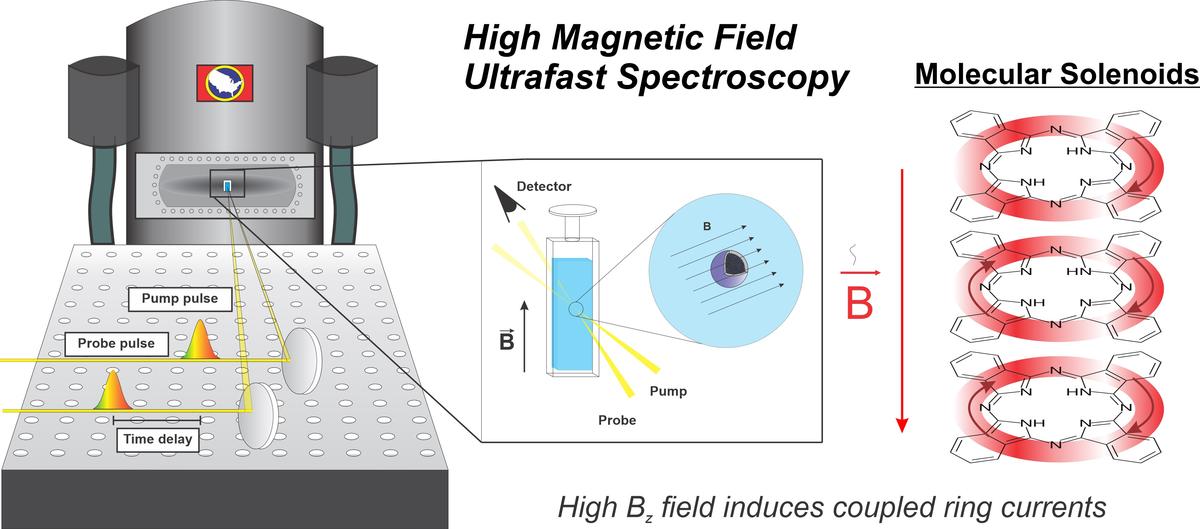
Applying magnetic fields is a powerful strategy to study the electronic properties of inorganic materials and paramagnetic organic systems due to their straightforward Zeeman interactions. We demonstrate with magnetic fields almost 1 million times stronger than that of Earth (up to 25 T) that we can perturb the optoelectronic properties of model “nonmagnetic” organic chromophores. These perturbations arise from the induction of ring currents in these aromatic molecules, which explains the increased relative magnetic sensitivity of the molecular aggregates in comparison to molecules in solution, in analogy to a molecular solenoid. Our results hint that magnetic fields may provide a new handle to control the optoelectronic properties of molecular systems to make new multifunctional and magnetosensitive organic devices.
| © The Trustees of Princeton University Scholes Laboratory | Frick Chemistry Laboratory |
 |